The German food delivery industry has gone through drastic changes in the past few years due to digitization, ever-evolving consumer behavior and growing expectations. To keep pace with technological advancements, restaurants have also embraced the change by adding facilities like online ordering, table reservations, and digital menus with real-time updates.
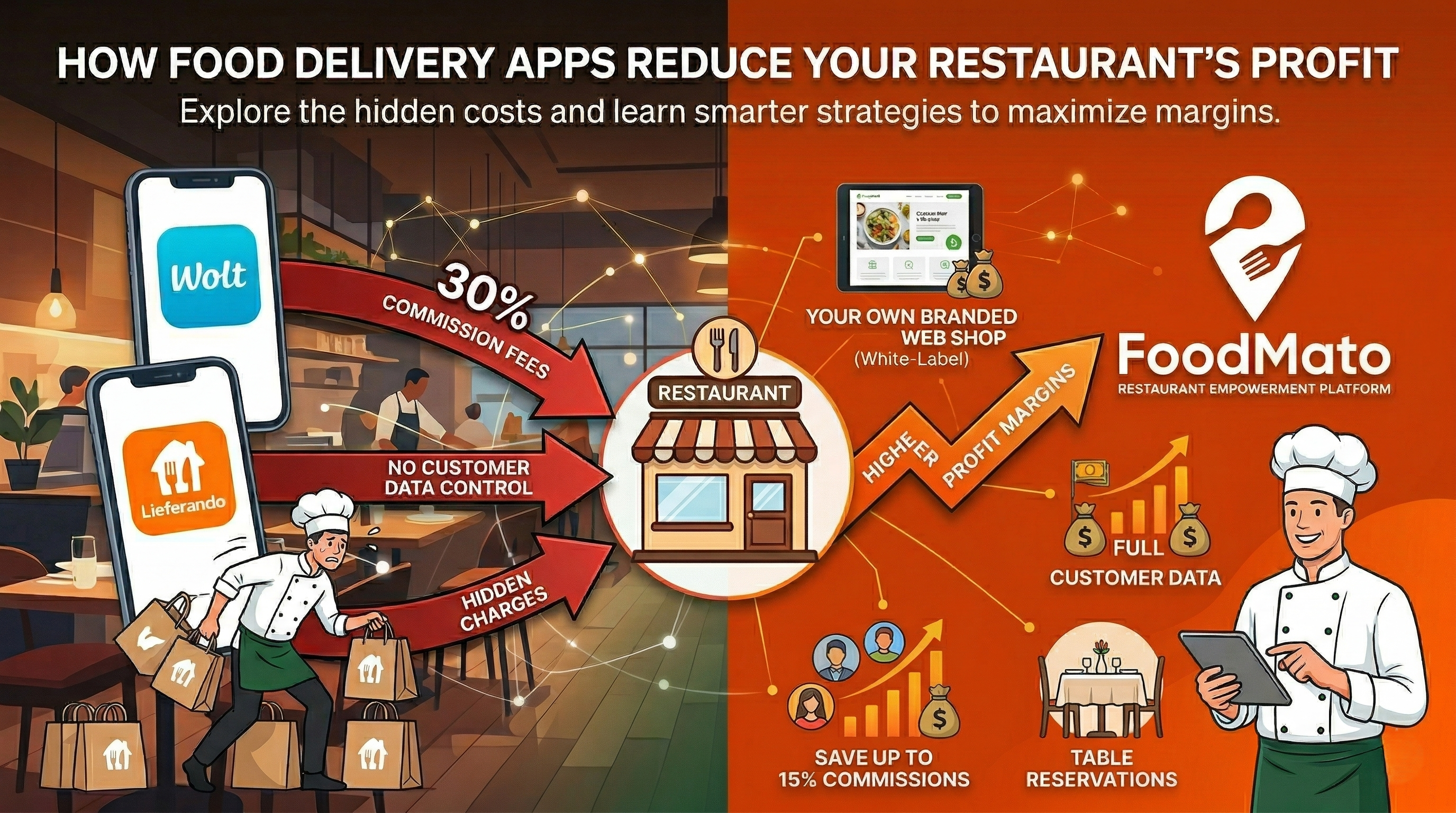
However, most restaurants depend on third-party food delivery platforms to offer these facilities to their customers. This ultimately eats up a huge share of their profits due to the hidden costs of third-party delivery platforms. If you too use such platforms to fulfill online food orders, you must understand the impact of delivery apps on restaurant profits.
Let us begin with the hidden cost of online food aggregators for restaurants.
Third-party delivery apps not only enable restaurants to sell their food online but also increase their menu exposure. Additionally, it offers diners the comfort of ordering food from their preferred restaurant to their homes. In exchange, they charge restaurants a significant amount of money that reduces their profit margins.
Let us discuss the food delivery apps’ impact on restaurants and the charges of these platforms:
1. Food deliveryapp commission fees
Third-party delivery apps like Wolt, Lieferando charge restaurants a high commission fee that considerably drains the owners’ profit levels. The fee can go up to 30% on each order. It becomes a big issue for small restaurant owners who already keep their profit margin low on a single dish.
Consider a situation in which a small restaurant owner is offering a specific dish at €10. He has spent €7 to prepare the dish which means he should earn €3 as profit.
However, if he sells that particular food item on a third-party delivery app, he has to pay €3 as the commission fee (30%). This means he gets €7 in hand which indicates zero profit. So clearly, to sell food items on such platforms, he either needs to increase its price or sell without profit.
2. Additional fees
Unfortunately, most delivery apps don’t stop at the commission fee; they impose additional charges for marketing placements, customer service issues, and payment processing. This further reduces your earnings. Restaurant owners struggle a lot to manage the fee structure of these platforms, but they often need to put up with this to satisfy their customer needs.
Besides this, sometimes restaurant owners need to pay for their operational inefficiencies. This is because it is nearly impossible for anyone to predict demand for specific food items as it fluctuates a lot on such platforms. For example, it is possible to witness a high demand for pasta today, but tomorrow it might be zero. Restaurants often make preparations in bulk to avoid shortage, but in the end, the food is wasted.
3. No control over customer data
Online food aggregators do enhance your audience reach by displaying your menu to a huge number of people, but unfortunately, the consumer data remains in their control. Those who order from your restaurant through the app become the app’s customer, not yours. This ultimately creates a barrier between you and your consumers. The most painful part here is that for any delivery-related issues, customers blame the restaurant, not the delivery platform, which also risks your brand reputation. So the cost of not being able to build a connection with your audiences should also be taken into account.
Now that you are aware of the real problem with such delivery apps, let us help you find a solution to this issue with some result-driven strategies to increase your restaurant’s profitability with delivery apps.
Strategies to increase restaurant profits
Food delivery apps are like double-edged swords. They increase your restaurant’s visibility but claim a major part of your profits and limit access to your customer data. Delivery apps are important for your restaurant, but using some effective strategies, you can surely increase your restaurant’s profit and reduce your dependency on such platforms.
Check your dine-in menu twice to understand if it is appropriate for delivery. A well-optimized food menu suitable for delivery is the key to increase profitability and efficiency.
Consider the following tips to make a delivery-appropriate food menu:
- Find out the most popular food items from your menu that are travel-friendly.
- Create a separate menu for online deliveries to avoid any confusion and kitchen inefficiencies.
- Focus on packaging that keeps food fresh and presentable during the journey from restaurant to customer doorstep.
- If needed, keep the prices slightly higher and give reasons behind it to earn customer trust.
2. Build your own online ordering system
The best solution to cut down on your high commission fees for third-party delivery apps is creating your own online ordering system for direct ordering.
Benefits of creating your own online ordering system:
- Zero commission per order.
- Full control over your customer data.
- The ability to manage food prices as per preferences.
- Helps you increase your profit as the entire amount goes to your pocket.
- Build better relationships with customers.
- Cost effective as you only have to pay for the restaurant management software and bear no additional charges on orders.
Creating your own online ordering system brings an endless number of advantages to your restaurant, but finding the right software can be a challenge here.
We recommend FoodMato as the best solution for all restaurant owners to enjoy all the facilities of an online delivery platform without the heavy burden of commission fees.
FoodMato is a revolutionary food delivery platform that not only helps you create your own online delivery system but also allows you to sell food on their platform with a small amount of commission charges. Sounds unreal, right? but this is true.
How FoodMato helps boost your restaurant profit?
FoodMato is a food delivery app that empowers your restaurant with a wide range of features including online ordering, delivery and table reservation without breaking the bank. It is a savior for restaurant owners who are struggling to earn profit due to third-party commission fees as its commission charges are much lesser than the major players in the market.
Let us understand the FoodMato model closely
FoodMato has completely transformed the way restaurants use third-party delivery platforms to sell food online. Restaurant owners can save up to 15% on commissions with the online delivery platform.
One of the biggest advantages of using FoodMato is the lower commission rates as compared to the traditional marketplaces which allows restaurants to earn more profit and deliver better food quality services.
Additionally, FoodMato follows a multi-tenant white-labeled infrastructure, that enables restaurants to have their own branded web shop while still benefiting from a central marketplace as well as a reservation system.
How do customers benefit from FoodMato?
FoodMato’s customers are restaurant owners who will benefit from it in the following ways.:
- Lower commission fee means restaurants do not need to inflate food prices to sell them on FoodMato.
- Loyalty rewards and wallet cashback system
- Faster delivery through an optimized local driver network
- Transparent pricing without any hidden or additional service markups
- Support for local restaurants instead of large corporate aggregators.
In a nutshell, FoodMato customers receive better value, services, and a more community-driven experience.
What makes FoodMato better than its competitors in the market?
FoodMato carries more advantages for restaurant owners than other popular delivery platforms
- Designed with a lower commission structure, allowing small restaurants to survive.
- Follows a white-label restaurant model that keeps your restaurant’s brand identity intact.
- Subscription & wallet ecosystem to maintain recurring revenue and customer retention.
- Table reservation system.
- Marketing automation.
FoodMato is not just another delivery app — it is a restaurant empowerment platform combined with a fair marketplace model. Save up to 15% compared to other platforms.
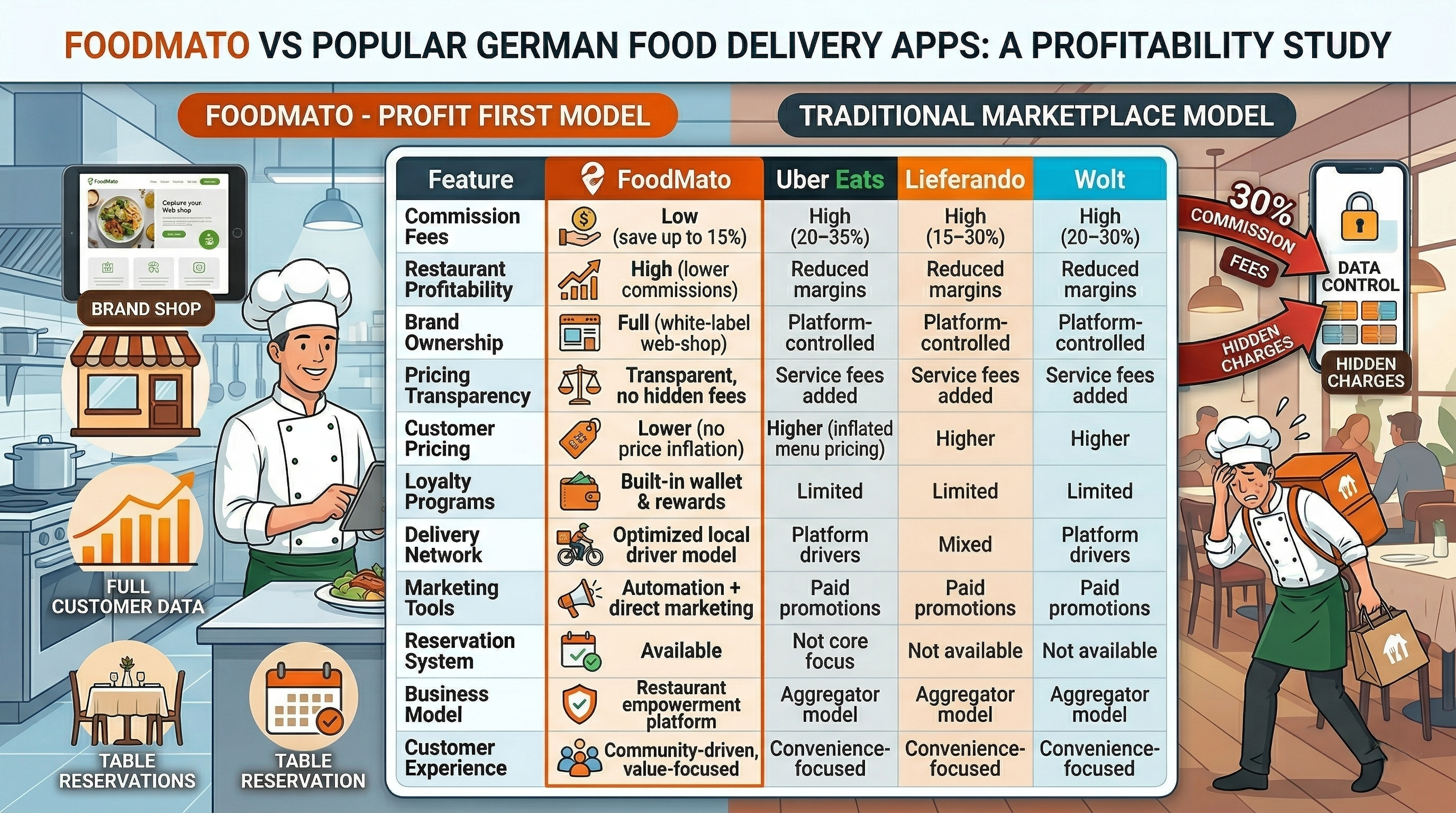
Here is a detailed competitive study between FoodMato and other popular food aggregators.
FoodMato vs Popular Food Delivery Apps in Germany
Are Delivery Apps Still Worth It?
Food delivery apps are still worth it, if you use them strategically. These platforms provide better visibility to restaurants and wider customer reach that are essential for them to grow. However, completely depending on them for online operations is certainly not a good idea. You need to maintain a balance. Instead of treating food aggregators as the primary source of revenue, you must treat it as a customer acquisition channel.
By using these delivery apps alongside a strong direct ordering system, you can maximize your profit level.
Unlike popular food delivery apps like Wolt, Lieferando, etc. FoodMato follows a profit-first model instead of commission first. It significantly reduces restaurant owner’s dependence on third-party platforms and allows them to grow.