

Something has shifted in the dining room. Walk into a well-regarded restaurant today and you’re less likely to find a towering tasting menu with seventeen micro-courses and more likely to find a tight, seasonal list of dishes you actually recognize — cooked with quiet precision and served with genuine warmth. The era of culinary one-upmanship is cooling down. In its place, a more considered, experience-first approach to dining out is taking hold.
After years of novelty-chasing and Instagram-optimised plates, 2026 is shaping up to be the year restaurants get serious about what actually matters: flavor, intention, and the human being sitting at the table.
Here’s what’s defining the restaurant landscape right now — and why it matters to every diner, not just the food industry insiders.
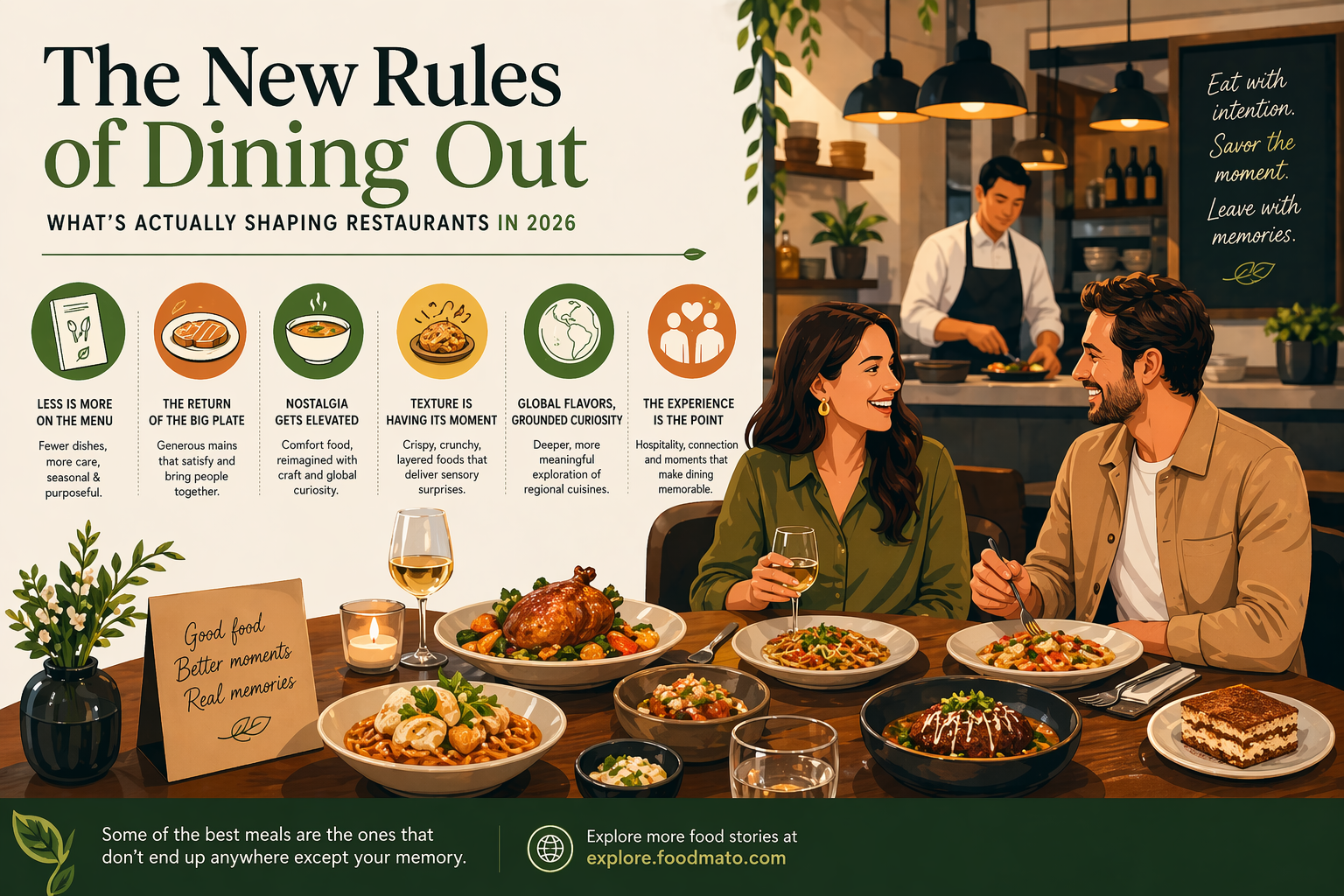
Less Is More on the Menu
One of the most notable shifts happening across restaurants globally is the quiet retreat of the sprawling menu. Chefs are trimming down their offerings, focusing instead on fewer dishes executed with more care. According to the James Beard Foundation’s conversations with leading chefs, smaller menus that rotate with the seasons are becoming the standard, built around what’s fresh, local, and purposeful — with simpler descriptions that let the food speak for itself.
This isn’t just an aesthetic choice. It’s also smarter business. Streamlined menus reduce waste, ease kitchen pressure, and signal confidence. A restaurant that does ten things brilliantly is far more compelling than one that does forty things adequately.
For diners, the payoff is real: you get better food, cooked by a kitchen that isn’t stretched thin.
The Return of the Big Plate
While small plates culture isn’t disappearing — and tapas-style sharing remains a popular social format — there’s a growing counter-movement: the return of the generous, unapologetic main course. Large-format entrées are making a comeback, and chefs are leaning into it.
The reasoning is straightforward. Not every diner wants to negotiate sharing arrangements across seven small dishes, and the perception (often accurate) that small plates don’t fill you up has started to wear thin. As value consciousness grows — restaurant prices are forecast to rise around 4.6% in 2026 — diners are increasingly asking: did I actually leave satisfied?
Expect more of the kind of food that centers the table: one-pot dishes, slow-roasted cuts, generous grain bowls, and whole-animal cooking that invites you to linger.
Nostalgia Gets Elevated
If there’s a single flavor profile dominating 2026, it might be memory. Diners are gravitating toward comfort — familiar tastes that carry emotional weight, reimagined with a little more craft and global curiosity.
The National Restaurant Association’s 2026 What’s Hot Culinary Forecast points to this tension between the familiar and the novel as a defining force in kitchens right now. The smashed burger, long a diner staple, is being reinvented as a smashed burger taco. Classic French bistro dishes — roast chicken, steak frites, rich one-pot braises — are showing up on menus from Hong Kong to Kuala Lumpur, reframed not as retro but as refined. Tiramisu, that endlessly adaptable Italian classic, is having a genuine cultural moment, appearing in unexpected formats across restaurant menus and coffee shops alike.
MICHELIN Guide inspectors tracking global dining have noted the same thread running through their visits: simplicity, executed with skill, is the new luxury. Consumers prefer honest cuisine in a warm atmosphere — grandma’s recipes, childhood memories, real food with a story.
Texture Is Having Its Moment
Less talked about than flavor, but just as important: texture has become a competitive edge in restaurant innovation. Crispy, crunchy, layered foods are generating genuine excitement — chili crisp as a finishing element, crunchy rice bases, crackling-topped dishes that reward you the moment you break the surface.
Industry analysts tracking millions of menu signals describe what they’re calling a “texture takeover” across restaurants globally. In an era where diners share experiences on social media, food that delivers a sensory surprise does more than taste good — it creates a moment worth remembering. Clever operators are building this into their menus deliberately, pairing textural contrast with nostalgic flavor bases for maximum effect.
Global Flavors, Grounded Curiosity
The appetite for cuisines beyond the familiar is not slowing down. But the nature of that curiosity is maturing. Post-pandemic culinary tourism left diners with a genuine education — and a hunger to go deeper into regional cooking, rather than simply sampling a broad sweep of “international” food.
In 2026, the most interesting movements are in the detail: new-wave Japanese techniques meeting local ingredients, Southern Asian regional cooking finally getting its due beyond the curry-house context, Eastern European flavors — pirogi, fermented vegetables, hearty one-pot dishes — entering more mainstream dining conversations. Food Network’s trend experts are also watching the rise of savory flavor profiles: the interplay of sweet and savory, driven by black garlic, fermented fruits, and black sesame, ingredients that deliver complexity without additives and carry genuine functional benefits.
The restaurant industry is learning that diners don’t just want global flavor — they want context, origin, and a chef who can tell them why it matters.
The Experience Is the Point
Perhaps the most significant shift of all is harder to put on a menu: 2026 is the year restaurants are doubling down on hospitality as the product.
Multiple industry observers — from MICHELIN inspectors to independent operators — are noting the same thing: diners have grown weary of performative dining. The phone-first, photograph-before-tasting culture is generating a quiet backlash, and some of the most exciting restaurants are actively designing spaces and menus that pull focus back to the moment of eating itself.
Counter seating — where guests sit close to the kitchen, watch their food being prepared, and connect with the team making it — is growing everywhere from Copenhagen to Québec. It creates immediacy and trust, and it makes the act of dining feel like a genuine exchange rather than a transaction.
The best operators, as one restaurateur put it, are “engineering sensory experiences” — not just cooking food, but designing entire moments. That’s a high bar. It’s also exactly what keeps people coming back.
What This Means for You
If you’re deciding where to eat in 2026, these trends offer a useful filter. Look for restaurants with shorter, rotating menus — they’re a reliable signal that the kitchen is buying carefully and cooking with intention. Seek out the places where service feels genuinely personal, not scripted. Be open to comfort food that’s been thought about: the dish that reminds you of something, made with more skill than you remember.
And when the food arrives, consider putting the phone down for a minute.
Some of the best meals are the ones that don’t end up anywhere except your memory.
Explore more food stories at explore.foodmato.com