Every time a customer orders from your restaurant on Wolt or Lieferando, up to 30% of that payment never reaches you. Not a typo. Up to €3 out of every €10 goes straight to a platform — before you’ve paid your staff, your rent, your ingredients, or your electricity bill.
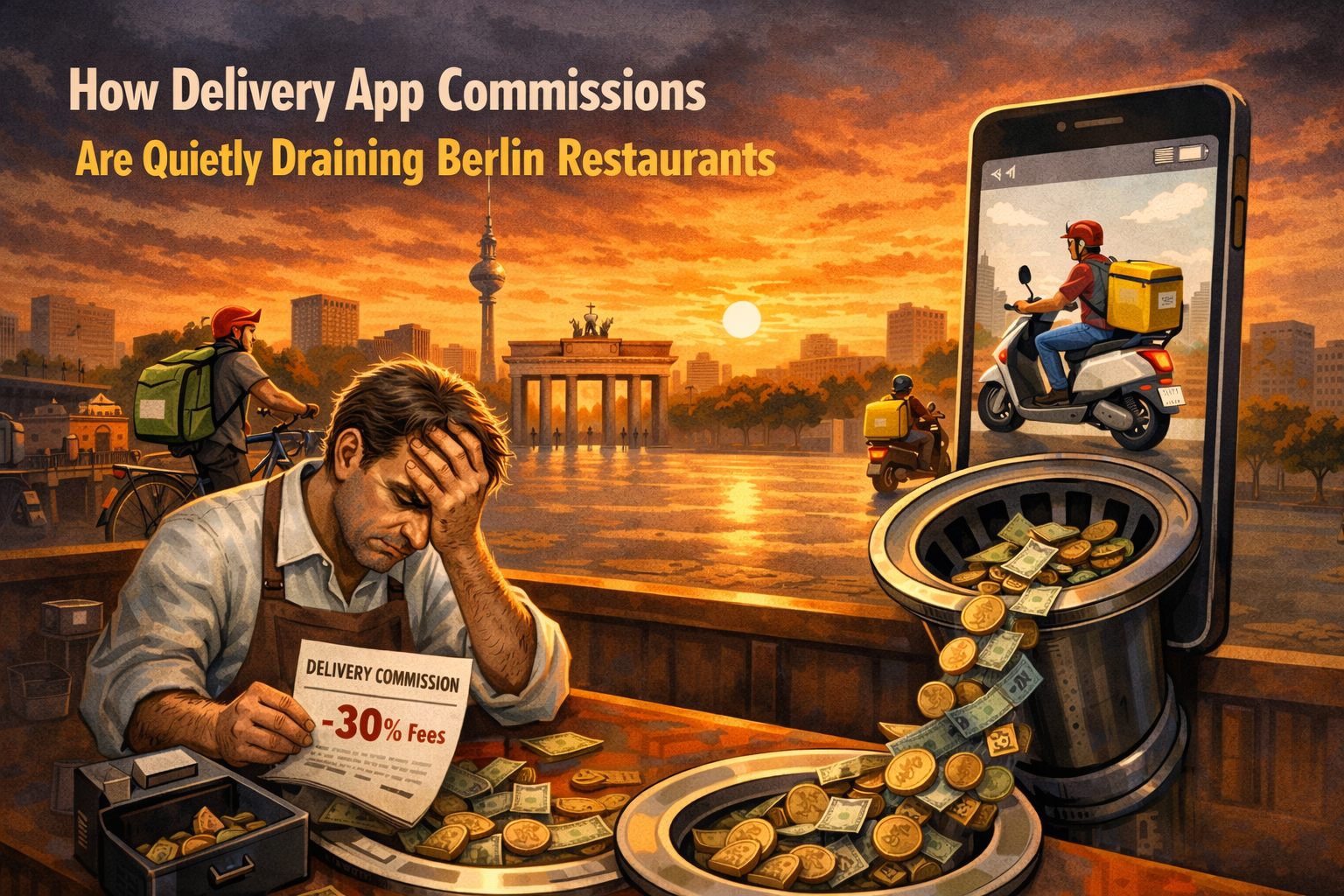
If you run a restaurant in Berlin, you already feel this. But most owners don’t do the math until it’s too late.
Let’s change that.
The numbers behind the platform deal
Berlin’s food delivery scene is dominated by three big names: Lieferando, Wolt, and Uber Eats. Together, they’ve become almost unavoidable — Lieferando alone is used by around 75% of German online food delivery customers. Being on these platforms means visibility. It means orders coming in even on a quiet Tuesday night. That part is real.
But the price of that visibility is steep.
Wolt charges restaurants between 25% and 30% per order when using their drivers. Lieferando can charge up to 30% per order. Uber Eats follows the same structure — up to 30% if you rely on their delivery network.
Now let’s make that real with simple numbers.
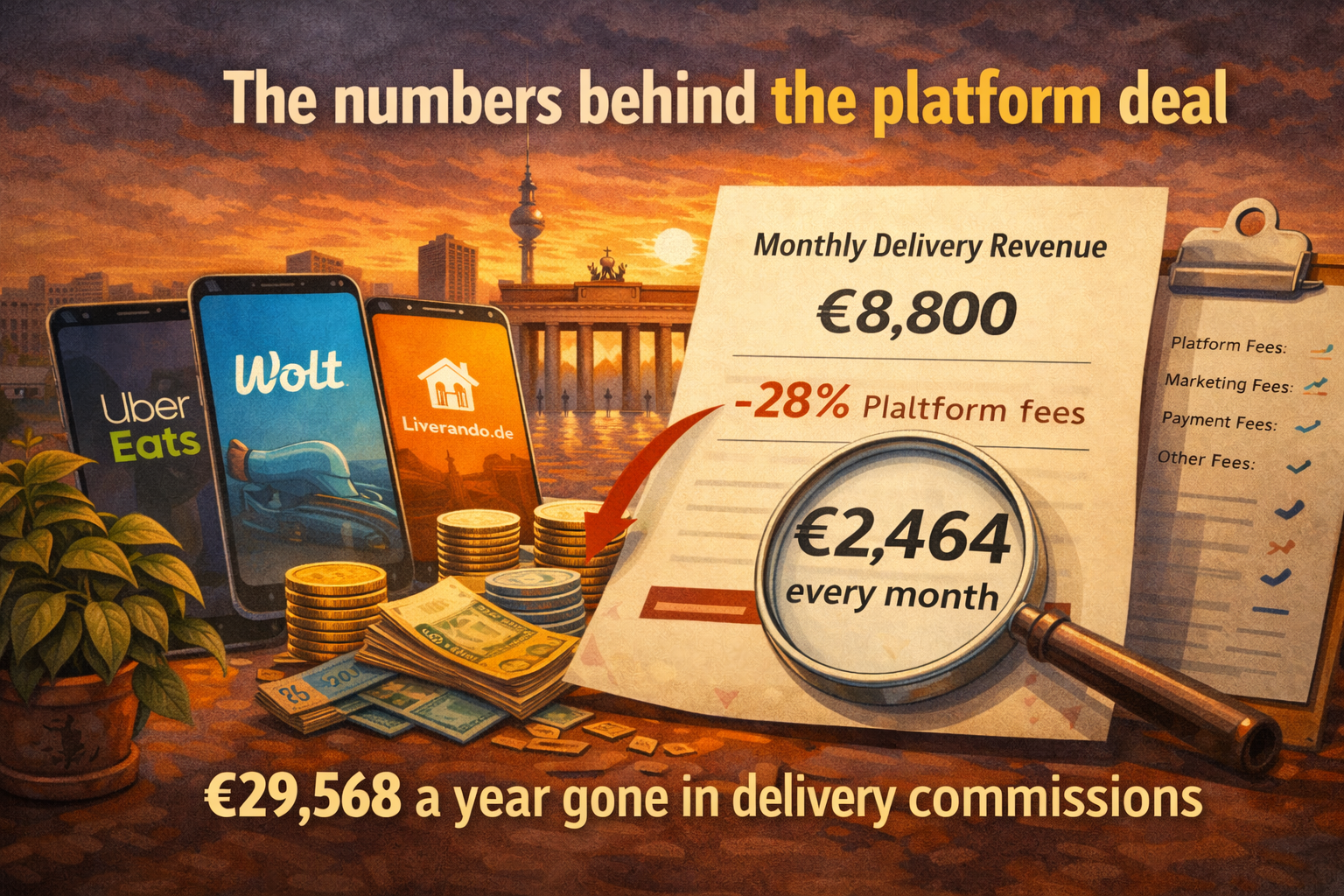
Say your restaurant does 400 delivery orders a month. Average order value: €22. That’s €8,800 in monthly delivery revenue — before costs. At a 28% commission rate, you’re handing €2,464 to the platform. Every single month. That’s €29,568 a year — gone, before a single ingredient is bought.
Moreover, that’s before the extra fees.
The fees you don’t hear about upfront
The headline commission is only part of the story. On top of that base rate, platforms also charge:
- Placement and promotional fees — pay to appear higher in search results, or your restaurant gets buried below competitors who do pay
- Marketing and campaign fees — discounts the platform runs using your margins, not theirs
- Payment processing fees — a small percentage on top of every transaction
The result is that your actual effective cost per order is often higher than the headline commission suggests. Some restaurant owners only realize this when they reconcile their monthly payout against their actual order volume and find the gap is wider than expected.
Here’s something Berlin diners might not realize: that Döner that costs €9 in the restaurant often shows up at €11.50 or €12 on the delivery app. Is the restaurant being greedy? Not usually.
They’re absorbing the commission.
When 28–30% of every order goes to the platform, restaurants face a choice: take the hit on their margins, or inflate their delivery menu prices to compensate. Most do a bit of both. Either way, someone pays — either the restaurant owner or the customer.
This is why food delivery has quietly become more expensive for everyone. The platform collects its cut, the customer pays more, and the restaurant still makes less than it would on a direct order.
The brand problem nobody talks about
Beyond the money, there’s something less visible but just as damaging: you don’t own your customers.
When someone orders from you on Wolt, their data — their name, email, order history, preferences — belongs to Wolt. Not you. You can’t email them when you launch a new menu. You can’t reward them for being regulars. You can’t run a birthday offer or a flash discount to bring them back on a slow Wednesday.
You’ve cooked their food, but you have no relationship with them. The platform does.
Moreover, if Wolt decides to change their algorithm, increase their fees, or push a competitor restaurant into your spot, there’s not much you can do. You’re a supplier to their marketplace, not a business building your own customer base.
What a fairer model looks like
The good news: the commission-heavy model isn’t the only one.
A new generation of restaurant platforms is built around a different idea — that restaurants should keep more of what they earn, own their customer relationships, and have a branded presence they control.
FoodMato is one of them. Built specifically for the Berlin market, FoodMato operates on a significantly lower commission structure than Wolt or Lieferando — so restaurants retain more margin on every order, without sacrificing the reach of a central marketplace.
Beyond commissions, FoodMato gives restaurants:
- Their own branded web shop — your name, your look, your identity. Not just another listing on a crowded app.
- A loyalty and cashback system — so your regulars are rewarded for coming back to you, not to the platform.
- A reservation system — combining delivery and table bookings in one place.
- Marketing automation tools — so you can actually reach your customers, not just hope the algorithm shows you to them.
The model is built on a simple belief: when restaurants are healthier businesses, they invest in better food, better service, and better experiences for customers. Everyone wins — except the platforms taking 30%.
What this means for you as a Berlin restaurant owner
If you’re currently on Wolt, Lieferando, or Uber Eats, you don’t necessarily need to leave tomorrow. These platforms have real reach and real customers, and for many restaurants, they’re still worth using — strategically, as one channel among several.
But building your entire delivery business on top of a 30% commission structure is not sustainable long-term. The math simply doesn’t work in your favor.
The question worth asking is: what would your business look like if you kept even half of what you’re currently paying in commissions? What could you invest in? What could you pay your team? What could you put back into your food?
That’s the conversation FoodMato is starting in Berlin.
Ready to see what lower commissions mean for your restaurant?
Foodmato is currently onboarding Berlin restaurant partners. If you want to understand exactly what the switch could mean for your margins — with no obligation.
Your food is worth more than 30%.